
Creamy Is Not a Prompt Instruction
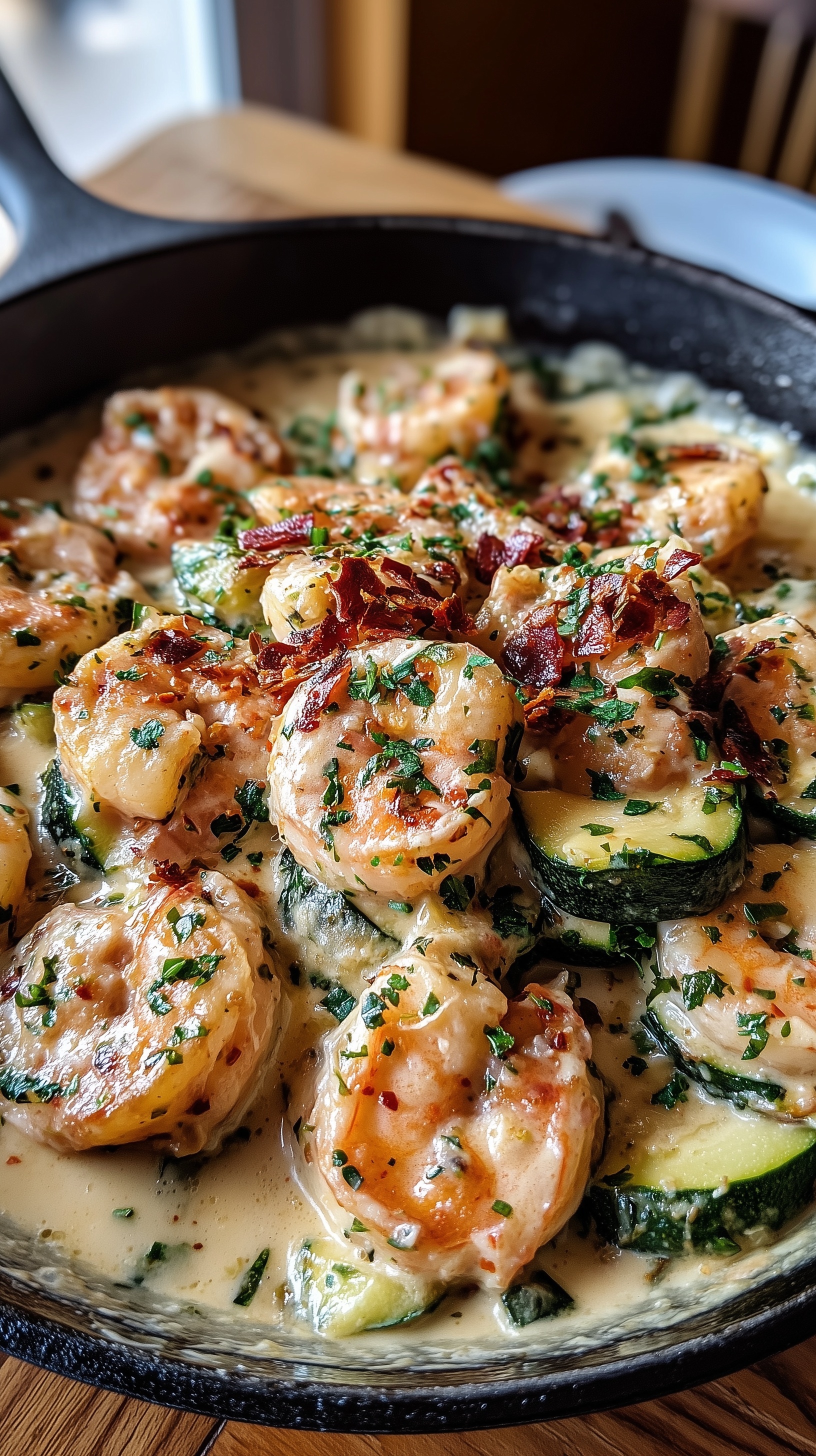
Overhead 90-degree tabletop photograph of a garlic shrimp and zucchini skillet, shot on 100mm macro at f/2.8, focal plane locked on the front third of the pan so rear shrimp fall into soft bokeh. Plump shrimp curled into tight C-shapes, shells removed, exposed flesh pink-orange with rust-brown Maillard crust following the convex curve of each segment, breaking into irregular patches rather than a flat painted stripe. Sauce is an off-white dairy emulsion at heavy-cream viscosity, surface tension pulling a concave meniscus where it meets each shrimp, glossy specular highlight shaped like the reflected window, 1-2mm bubbles clustered at the pan edge where the emulsion still reduces. Zucchini rounds cut 1.5cm thick, pale green cut faces carrying brown grill bars, dark green skin ring intact. Bacon crumbled into irregular shards, deep mahogany, translucent rendered fat at the edges. Flat-leaf parsley and chives chopped fine, individual leaf edges legible, several half-submerged in sauce. Thin steam wisps only at the left rim, never crossing the food. Rustic black cast iron with matte seasoned patina and micro-pitting. Weathered oak table, grain running diagonally under the pan. Single soft window light from upper left at 3200K rim-lighting the meniscus and shrimp edges, cool sage-green bounce fill in background shadows. Warm amber and sage palette. --ar 4:5 --style raw --s 250
Quick Tip: Click the prompt box above to select it, then press Ctrl+C (Cmd+C on Mac) to copy. Paste directly into Midjourney, DALL-E, or Stable Diffusion and customize to make it your own!
"Creamy" is a category label, not a rendering instruction. It describes a judgment about mouthfeel rather than a measurable optical property, so a diffusion model has nothing geometric to attach it to. The word survives in prompts because it feels descriptive, but functionally it delegates the entire texture decision to whatever the training distribution happens to associate with it.
What the Word Actually Retrieves
When "creamy" enters the text encoder, it lands in a region of embedding space shared by dairy, soup, sauce, foam, and blurred backgrounds. That neighborhood has enormous variance. The sampler then resolves the prompt against many mutually incompatible renderings at once — a matte paste, a translucent gel, a blown-out white puddle — and the average of those is what you get. Flat, evenly lit, and textureless in the specific way that makes food renders look synthetic.
The fix is not to add more adjectives. It is to describe the physical state of the sauce instead of the impression it produces. "Off-white dairy emulsion at heavy-cream viscosity" gives the model a color, a material class, and a thickness tier. Viscosity language works because thickness implies geometry: how a liquid meets a solid edge, how far it climbs, whether it pools or sheets. Geometry is something the denoiser can actually draw.
Surface tension is the second lever. Naming a concave meniscus where sauce meets each shrimp tells the model that the liquid is adhering rather than sitting on top, and that single relationship produces the wet-contact look that reads as freshly cooked. Without it, sauce tends to be composited flatly across the food like a decal, which is the most common giveaway in generated food photography.
The specular highlight deserves the same treatment. "Glossy" alone is close to meaningless, but "a glossy specular highlight shaped like the window it reflects" forces a coherent reflection with a defined source geometry. Because the highlight now carries the scene's lighting logic, the shrimp edges and the meniscus rim can share it, and the frame stops looking lit from nowhere.
How the Sampler Routes Viscosity Language
Diffusion resolves a frame in layers. Early steps commit the low-frequency structure — where the pan sits, where the sauce pools, where the shrimp cluster. Later steps fill in micro-texture. This matters because a sauce description only influences the pool boundaries if it is present when those boundaries are being decided. Push the sauce language to the very end of a long prompt and it may only affect the final surface pass.
That is the practical argument for placing the emulsion clause immediately after the subject clause rather than burying it behind garnish detail. It also explains why micro-detail like "1-2mm bubbles clustered at the pan edge" behaves differently from the meniscus instruction: the bubbles are a late-step texture, while the meniscus is an early-step silhouette. Both belong in the prompt, but they are doing separate jobs at separate noise levels.
Scale is the other routing problem. The model has no absolute units, so "1-2mm" only means something because the frame contains known objects. Shrimp of a recognizable size and zucchini rounds cut 1.5cm thick act as rulers. Remove those anchors and the bubble specification becomes decorative noise that the sampler can satisfy at any scale it likes.
Embedding Contrast Instead of Negatives
The Maillard crust clause carries an instruction inside a description: rust-brown crust that follows the convex curve of each segment and breaks into irregular patches instead of a flat painted stripe. That final phrase is doing negative work without a negative flag. Naming the failure mode inline keeps the correction adjacent to the thing being corrected, which tends to hold better than a separate exclusion term appended far away in the prompt.
The same logic governs multi-surface objects. Zucchini rounds cut 1.5cm thick, pale green cut faces with brown grill bars, dark green skin ring intact — three materials on one object, each with its own reflectance. Treating each element as a discrete unit with its own material identity is the same discipline used in puzzle-piece portrait construction, where every segment must carry independent surface logic or the whole reads as a single flat texture.
Where Depth of Field Meets the Sauce
A 100mm macro at f/2.8 produces a working depth of field measured in millimeters. Locking the focal plane on the front third of the pan means only the nearest shrimp and the sauce immediately around them can hold a sharp specular highlight. Everything behind falls into bokeh, and the emulsion there becomes a soft gradient rather than a surface. That gradient is what sells the depth; the sharp foreground is what sells the material.
If the plane is left unspecified, the sampler chooses its own focal point and reliably picks the brightest specular blob in the frame. The result is a sharp highlight floating on a soft subject, which reads as a focus error. Steam follows the same rule. Restricting wisps to the left rim and forbidding them from crossing the food keeps the highest-variance element in the composition away from the crust, whose legibility depends on uninterrupted micro-contrast.
Failure Modes and Parameter Trade-offs
Over-specification is the predictable failure. Attention is distributed across tokens, so a prompt with twenty micro-details gives each one a fraction of the influence it would have alone. The crust, the bubbles, the parsley edges, and the table grain all compete, and the render comes back correct in every category and convincing in none. The judgment call is to keep only the three or four elements that carry the frame and let the rest resolve from the model's prior.
Stylize interacts directly with this. At --s 250 with --style raw, the aesthetic prior is held back and photographic neutrality dominates, which is what preserves irregular crust and unretouched bacon shards. Raise stylize and the model re-smooths those irregularities toward a cleaner, more editorial look. The threshold moves between versions, so the honest approach is to treat stylize as a variable you re-test rather than a value you inherit. The same applies to any layered surface description, where smoothing erases the exact detail you specified. Current parameter behavior is documented at Midjourney.
The Boundary of This Approach
Describing physical state instead of impression stops working when the subject has no geometric anchor at all. Steam, aroma, and "creaminess" in the abstract cannot be drawn, only implied by the surfaces around them. The signal that you have crossed the boundary is a render that looks plausible but generic — clean, correctly lit, and completely unmemorable — with re-rolls that change almost nothing because the prompt's variance was already collapsed by vague terms. When that happens, stop adding words and start converting adjectives into measurable behavior.
Label: Product
Key Principle: Swap every mouthfeel adjective for a measurable surface behavior: viscosity tier, meniscus shape, bubble diameter, highlight source. If the word cannot be drawn as geometry, the sampler will average it away.