
I Tested Showa Kawaii Snowboard Cats
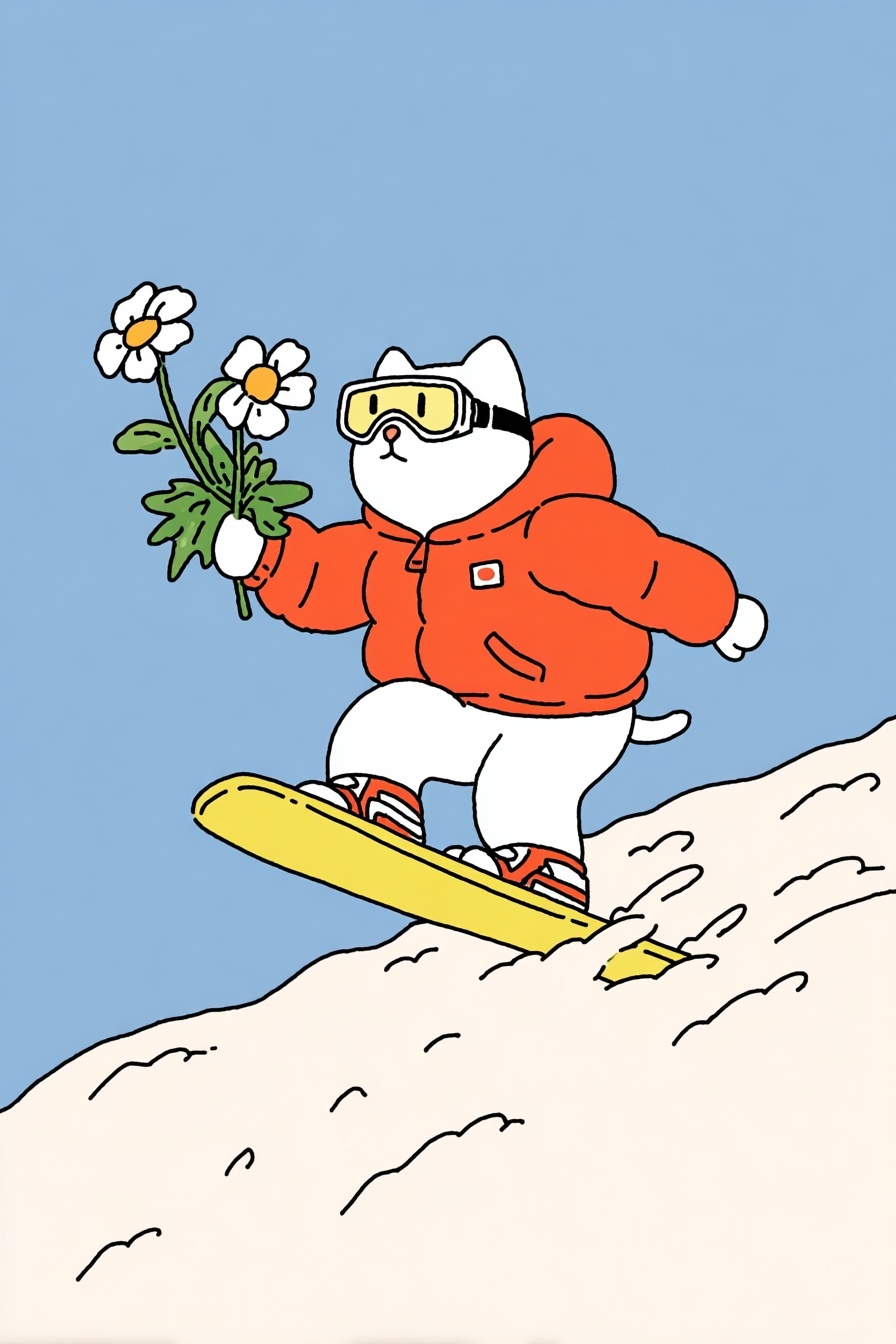
A plump, adorable white cartoon cat drawn in authentic Showa-era kawaii character style (1960s-1980s Japanese mascot design), with an oversized round head and a wide inflated torso, wearing oversized ski goggles in #FFD23F and a puffy orange winter jacket #FF6B35 with a small Japanese flag patch (one red accent only) on the chest. The cat snowboards down a gentle cream-white powder slope #FFFFFF marked with simple wavy hand-drawn texture lines suggesting powder drift, riding a bright yellow snowboard #FFD23F. Right paw raised holding a bouquet of white daisies with orange centers and green stems #228B22; left paw extended outward for balance. Background: flat periwinkle blue sky #87CEEB, no clouds, no gradient, no horizon line. Minimalist line art, thick uniform black outlines at 3-4px weight, flat cel-shaded color fills only, zero gradients, zero rim light, zero soft shadow, clean vector aesthetic. Character centered, 2/3 body visible, snowboard angled exactly 30 degrees to suggest gentle descent. Strictly limited palette: #FF6B35, #FFD23F, #FFFFFF, #87CEEB, #228B22, plus one red accent for the flag. Playful, wholesome mood. --ar 2:3 --style raw
Quick Tip: Click the prompt box above to select it, then press Ctrl+C (Cmd+C on Mac) to copy. Paste directly into Midjourney, DALL-E, or Stable Diffusion and customize to make it your own!
This prompt type fails in a predictable way. Feed a short kawaii cat description to any diffusion model and it returns a soft-shaded chibi with glossy goggles, gradient fur, and a blurred sky. The word kawaii dominates the embedding and pulls the render toward modern anime cel shading, which always includes a soft-shadow pass. Showa-era alone does not counteract it, because training captions almost never date-stamp 1960s-1980s Japanese mascot art. The style you asked for and the style you receive are two different decades.
The second failure is mass. Plump is read as large round head, slim body, which is the chibi default. The result is a bean-shaped head on a stick torso, with the snowboard shrunk to a sliver and the puffy jacket rendered as a thin shell. Volume has to be named explicitly and tied to a garment rather than to the animal. Plump cat fails; puffy orange winter jacket on a plump cat holds the silhouette.
The third failure is palette bleed. Without hex anchors, orange drifts to salmon or crimson, the yellow board goes neon, and the flat periwinkle sky acquires a radial gradient because the model interpolates between color words instead of reading them as fixed values. Hex codes constrain the color embedding, but only when each value is attached to a specific object. A bare list of hex values at the end of a prompt is
Label: Assets
Key Principle: In Showa kawaii prompts the outline weight is the style. Declare 3-4px uniform black linework before any hex code, or the model defaults to soft anime shading and the 1960s mascot look disappears entirely. If you want to go deeper, read steampunk whiskey bottle product and minimalist futurist dj exact prompt for.