
3 Weathering Tricks That Make AI Skull and Crossbones
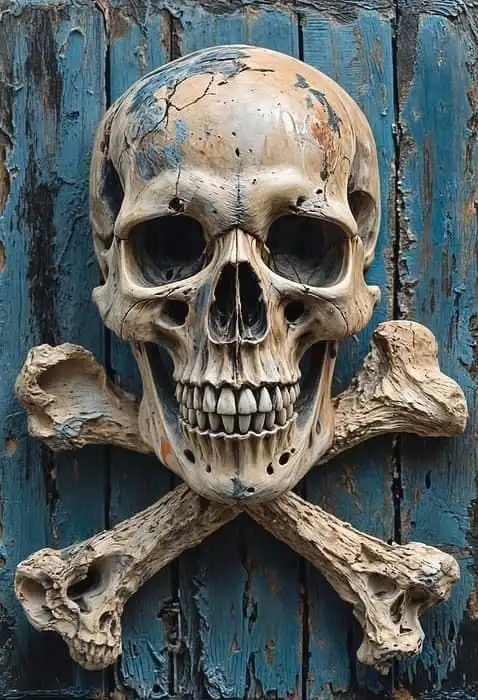
Quick Tip: Copy the prompt with the button above — paste it into Midjourney as-is (--ar and --style raw included). On DALL-E, Flux, Stable Diffusion, Ideogram, Leonardo AI or Firefly, keep the descriptive text and drop the -- flags. Try the same scene at two different aspect ratios: composition and light falloff change more than you'd expect.
Prompting the Process of Decay, Not Just the Appearance of It
Here's a counterintuitive thing about AI image generation: the word 'ancient' produces worse results than the phrase 'hydrolytic degradation.' One is a mood, the other is a mechanism. Most prompt writers reach for adjectives like 'old,' 'rustic,' or 'grungy' when they want a weathered skull and crossbones, but those words carry zero physical information. They describe how you want the viewer to feel, not what the surface actually did over centuries. The model has no instructions to work with, so it falls back on a generic sepia-and-cracks cliché that reads as costume prop rather than excavated artifact.
The fix is to write like a forensic anthropologist instead of an art director. Bone doesn't just 'get old' — water molecules break down its collagen matrix, minerals leach out, and the result is a specific yellowed patina with surface flaking and hairline cracking. Because training data includes archaeological conservation reports, museum documentation, and forensic papers, the phrase 'hydrolytic degradation' pulls from a far richer visual pool than 'old bone' ever could. You're not describing a vibe; you're citing a documented physical process the model has actually seen rendered in detail.
This mechanism-first approach scales across every material in the frame. 'Osteoporotic pitting at parietal eminences' does double duty: it names the texture (small eroded pits) and pins it to an anatomically correct location on the skull. 'Trabecular marrow structure' tells the model to render the spongy lattice inside a broken femur — but it only works if you also specify the femurs are broken open, because the model can't show interior anatomy you never gave it permission to expose. Precision in the prompt becomes precision in the pixels.
The broader lesson applies to any aged or damaged material you'll ever prompt. Before writing a single adjective, ask what physically happened to the object. Rust is oxidation. Silvered barn wood is UV-driven lignin breakdown. Cracked ceramic glaze is thermal expansion mismatch between the glaze and the clay body. Each of those phrases gives the model a causal story with documented visual consequences, instead of a vague emotional target. Once you internalize the pattern, the mechanism becomes the prompt — and 'old' becomes a word you never need again.
Lighting for Surface Documentation, Not Drama
There is a genuine tension in this image between mood and legibility. A skull invites dramatic treatment — low-key lighting, deep blacks, theatrical shadow. But the prompt's entire value proposition is micro-texture: crack networks, pitting, paint fracture. Hard or directional-dramatic light destroys that information two ways: specular hotspots blow out the pale bone highlights, and deep shadows swallow the recessed detail.
The solution is borrowed directly from conservation photography, where the goal is maximum recoverable surface information. "Cold overcast skylight from 45° elevation" specifies a large, diffuse source — effectively an enormous softbox — positioned high enough to model three-dimensional form. The 45° elevation is doing precise work: light from directly overhead flattens texture (this is why noon sun kills landscape detail), while light at 45° rakes across surface relief enough to give every crack and pit a small, readable shadow without creating contrast the sensor can't hold.
Notice also what this lighting does narratively. Overcast light is emotionally neutral — clinical, even. That neutrality is what makes the image feel like evidence rather than decoration, which is a far more unsettling register than theatrical darkness. If you're exploring darker, more narrative-driven horror aesthetics, the Billy puppet horror prompt demonstrates the opposite approach, where controlled theatrical light carries the menace. And for character-driven macabre work, the Frankenstein's monster prompt shows how similar forensic skin detail works on a living subject.
Complementary Color Separation Without Saturation
The palette instruction — warm umber bone against faded teal-blue wood — is a muted complementary scheme, and it solves a problem most aged-material prompts get wrong. When subject and background are both "brown and weathered," the image collapses into monochrome mush. The naive fix is saturation contrast: make the background vivid blue. But a saturated background reads as a studio backdrop and instantly breaks the fiction that everything in the frame has aged together.
The correct approach is hue separation with matched saturation and value. Bone sits in the orange-amber family; the wood sits in the blue-teal family. These are near-complements on the color wheel, so the subject separates cleanly from the ground. But both are desaturated to the same degree — faded, chalky, aged — so the frame maintains tonal unity. The skull pops not because it's brighter or more vivid, but because warm advances and cool recedes.
The background's own degradation details reinforce this. "Iron oxide bleeding from corroded nail heads" introduces small warm rust notes into the cool field, and "alligator cracking exposing bare wood" reveals warm raw timber beneath the teal paint. These warm echoes inside the cool background tie subject and setting together — a technique worth borrowing from the grunge street art portrait, where flecks of the subject's palette embedded in the wall create the same cohesion.
Optics: Why f/5.6 and Focus Stacking Coexist
The camera language — 90mm macro at f/5.6 with a "focus-stacking aesthetic" — encodes a specific photographic reality. At macro distances, depth of field is razor-thin even stopped down; at f/5.6 on a 90mm macro, you might get a few millimeters of sharpness. Real conservation photographers solve this with focus stacking: capturing dozens of frames at incremental focus distances and merging them into one image that is sharp from the nearest bone fragment to the back plank.
Midjourney and similar models have ingested enormous quantities of focus-stacked macro photography, so the phrase reliably produces that signature look: uniform front-to-back sharpness with a slightly hyperreal, almost illustrative clarity. If you instead asked for f/1.8 shallow depth of field here, you'd get a cinematic image where one eye socket is sharp and everything else melts — beautiful, but the crack networks and paint failure you spent the whole prompt building would dissolve into bokeh.
The aperture choice matters as a stylistic signal even though the model doesn't simulate optics literally: f/5.6 reads as "documentation aperture," reinforcing the forensic register established by the lighting and vocabulary. You can test these parameter interactions directly in Midjourney, and the prompt also transfers well to Adobe Firefly, which handles the muted archival palette particularly cleanly.
Where to Take This Next
The framework here — mechanism-based aging, documentation lighting, muted complementary separation, stacked-macro optics — is a template, not a one-off. Try swapping the subject while keeping the system: a corroded brass diving helmet on oxidized copper sheeting, a flaking porcelain doll head on silvered barn wood, a rust-pitted anchor against verdigris ship hull plating. Each substitution should name its own degradation chemistry. Once you can articulate how any material fails, you can direct the model to render age with the authority of a conservator's report — and that skill transfers to every weathered surface you'll ever prompt.
Key Principle: Replace adjectives ("old," "weathered") with named degradation mechanisms (hydrolytic, alligator cracking, trabecular exposure) — the model renders processes it can identify, not vague conditions. If you want to go deeper, read epic fiery hellhound ai art prompt for.