
Are You Making This Motion Blur Mistake in AI Prompts?
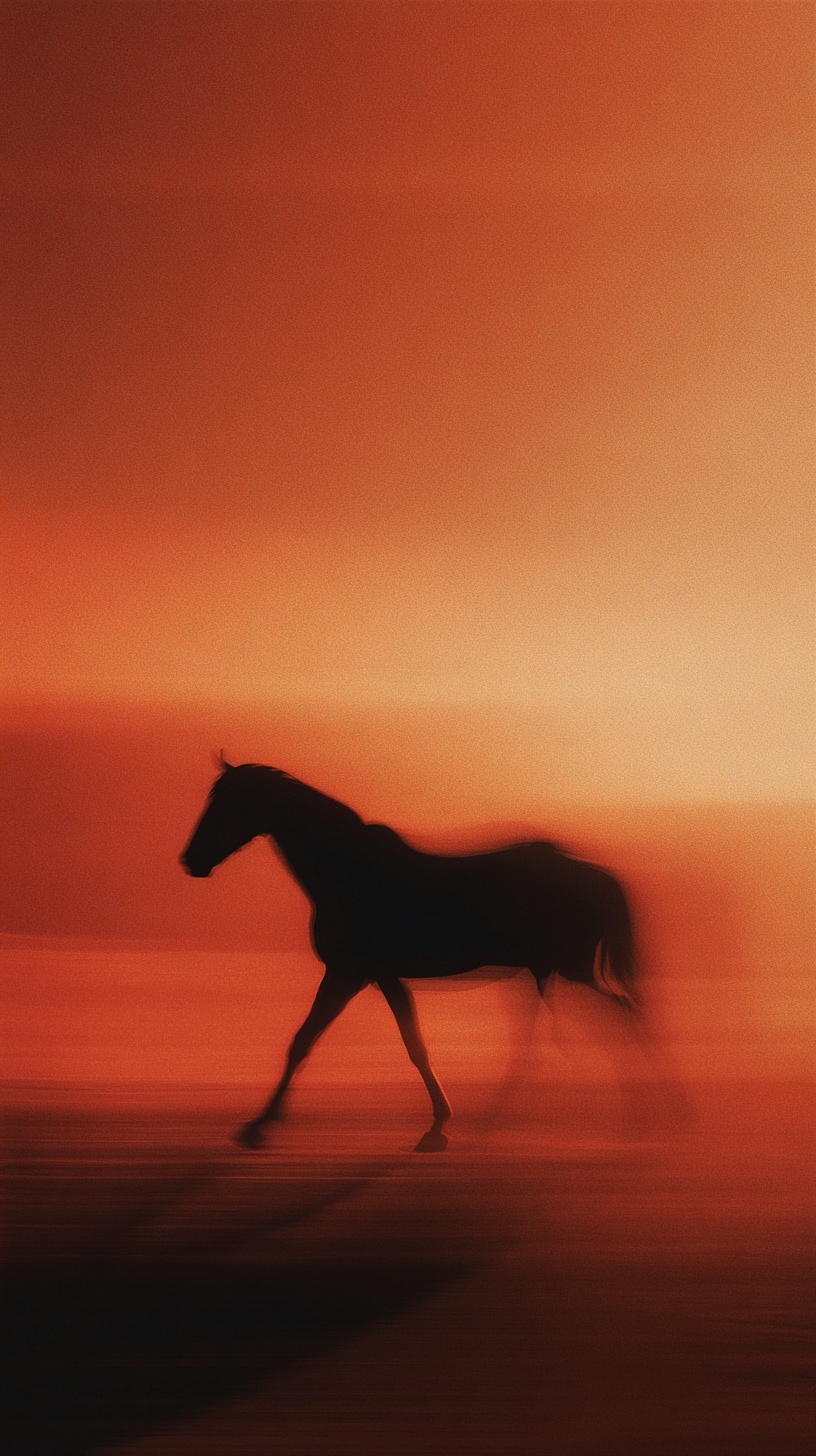
Fine art photograph of a lone horse galloping left to right across a desert horizon, rendered as a near-solid black silhouette against a blazing amber sunset sky. Selective motion blur assigned by anatomy: the legs and tail streak horizontally into soft velocity trails, while the head, neck, and torso remain tack-sharp with a hard, clean edge unaffected by blur. Slow-shutter panning technique at 1/15s with the camera tracking the horse, so the ground and horizon dissolve into parallel horizontal smear while the body core holds focus. Extreme backlighting from a low sun directly behind the subject creates a thin rim of light along the mane and topline, kept as a crisp thin line rather than a soft halo; the body interior falls to absolute black with no visible detail. Color palette limited to burnt sienna #8B4513, rust orange #B7410E, smoked paprika shadow #7A2E0F, fading to hazy peach #FFDAB9 across the upper third. Subtle 35mm film grain with restrained halation blooming along the high-contrast silhouette edge. Faint anamorphic lens flare bleeding horizontally along the horizon line. Atmospheric haze compresses the distant desert into flat indistinct color fields. The ground reflects the sky as muted desaturated horizontal bands with motion smear matching the leg trails. 200mm lens, wide open, shallow depth of field. Cinematic 21:9 framing with the horse placed low and generous negative space above, all four legs inside frame. Contemplative, untamed mood. Shot on expired Kodak Vision3 500T 5219, pushed one stop to ISO 1000, bleach bypass process for elevated blacks and reduced saturation. --ar 21:9 --style raw --s 200 --q 2
Quick Tip: Click the prompt box above to select it, then press Ctrl+C (Cmd+C on Mac) to copy. Paste directly into Midjourney, DALL-E, or Stable Diffusion and customize to make it your own!
Adding the phrase motion blur to a prompt feels like the obvious way to get a horse streaking across a sunset. It usually produces the opposite: a soft, mushy frame in which the head, neck, and torso — the parts that must stay razor-sharp — lose their edge along with everything else. The blur vocabulary never attaches itself to the legs and tail. It attaches to the entire canvas, and the result reads as a focus error rather than speed. That gap between expectation and outcome is worth understanding before spending another credit.
The reference point is a real panning shot. A photographer tracks a galloping horse with a slow shutter, roughly 1/15s, and the camera moves with the animal's core. Because the sensor and the torso travel at nearly the same speed, the torso renders sharp; the legs, which swing forward and back, and the background, which moves relative to the frame, smear into horizontal streaks. Selective blur is therefore a relationship between subject motion and camera motion, not a texture applied to a picture.
What Selective Motion Blur Actually Means in a Generated Frame
In a diffusion model there is no shutter and no sensor. The model has no physics engine tracking a horse. What it has is a statistical memory of how blurred photographs look, learned from captions and pixels. When a prompt asks for selective motion blur by anatomy, it is not triggering a simulation — it is building a spatial map. The text has to state which regions receive velocity streaks and which regions receive hard edges, because the model will otherwise apply one average treatment across the whole frame.
That distinction matters because most prompt writers treat blur as a filter strength. In generation, blur behaves more like a mask. The words legs and tail, placed next to streak and velocity trail, act as region selectors. The words head, neck, and torso, placed next to tack-sharp and hard clean edge, act as counter-selectors. If either half of that pairing is missing, the model has no reason to split the frame, and the two instructions collapse into a single compromise value.
Before going further, run one control test. Generate the scene with only the phrase motion blur and nothing else that describes sharpness. Inspect the head at 100 percent zoom. In most outputs the silhouette edge will be soft, the mane will lose its individual strands, and the rim light will spread into a halo. That softness is the baseline the rest of the prompt has to fight against.
How the Model Interprets the Phrase "Motion Blur"
The token motion blur carries baggage. In the caption data that trains image models, the phrase appears most often on photographs that are simply out of focus, on low-light snapshots, and on accidental camera shake. The model has learned to associate it with reduced edge contrast, lower local detail, and a general veil over the image. It has not learned to associate it with a stationary sharp core, because that combination is rare in training captions and almost never described in words.
The practical consequence is conflict averaging. When a prompt says motion blur and tack-sharp in the same breath, with no spatial anchor tying each adjective to a named body part, the model resolves the contradiction by meeting in the middle. Everything becomes mildly soft. Binding the adjectives to nouns — legs streak, head tack-sharp — gives the attention mechanism something to attach each descriptor to, which is the same anatomy-scoped logic used in this sports-figure prompt breakdown.
Sampler settings interact with this. A high stylize value, such as --s 750, pushes the render toward a smoothed aesthetic and quietly erodes hard edges, which works against a sharp torso. Lowering stylize toward 100–250 preserves edge fidelity and gives the anatomy split a chance to survive. The --style raw flag reduces default beautification but does not localize blur on its own; it only removes one source of interference. Midjourney's parameter documentation at midjourney.com is the reference for how stylize and raw interact.
Assigning Blur by Anatomy: Legs, Tail, Head, Torso
Write the blur assignment as a list of parts with a direction attached to each. Legs and tail streak horizontally into soft velocity trails. The mane tips dissolve backward. The head, neck, and torso hold a hard, clean edge. Direction matters because horizontal streaks and radial streaks produce
Label: Cinematic
Key Principle: Blur is a mask, not a filter: bind every blur adjective to a named body part and every sharpness adjective to its counter-part, or the model averages both into uniform softness. If you want to go deeper, read 7 things i got wrong about matchstick.